
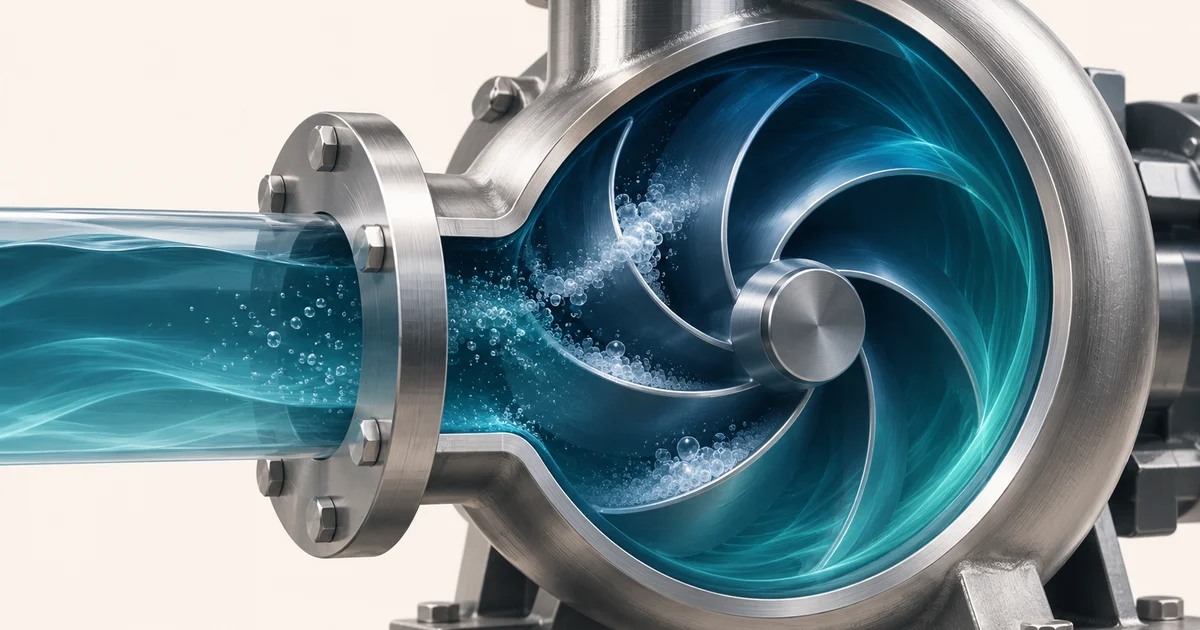
Pump cavitation happens when pressure inside a pump drops enough for vapor bubbles to form in the liquid. As the bubbles move to a higher-pressure area, they collapse. This can cause noise, vibration and damage over time.
Think of it as a warning that conditions inside the pump may not suit the liquid or the way the system is running. This article helps you recognize possible signs, collect useful information and know when to involve a pump specialist.
A rattling sound or loss of flow may indicate cavitation, but neither proves it. Air entering the suction line, an obstruction, a worn bearing or another mechanical problem can produce similar symptoms. Diagnose the complete installation before replacing parts.
Wilo's cavitation guide describes vapor bubble formation and common causes and warning signs. The following checklist turns those concepts into information a maintenance or procurement team can collect.
First: what should you do if a pump sounds wrong?
- Record what changed: the sound, flow, pressure, tank level and liquid temperature. Note when the problem started.
- Check the equipment manual and your site’s operating procedure. If operation appears unsafe, follow that procedure and contact the responsible technician.
- Do not open a pressurized pump or touch moving parts. Before inspection, qualified personnel should isolate the equipment and follow site electrical and pressure-release procedures.
- Share the readings and pump model with the person diagnosing the problem. Noise alone does not prove cavitation.
What happens during cavitation in a centrifugal pump?
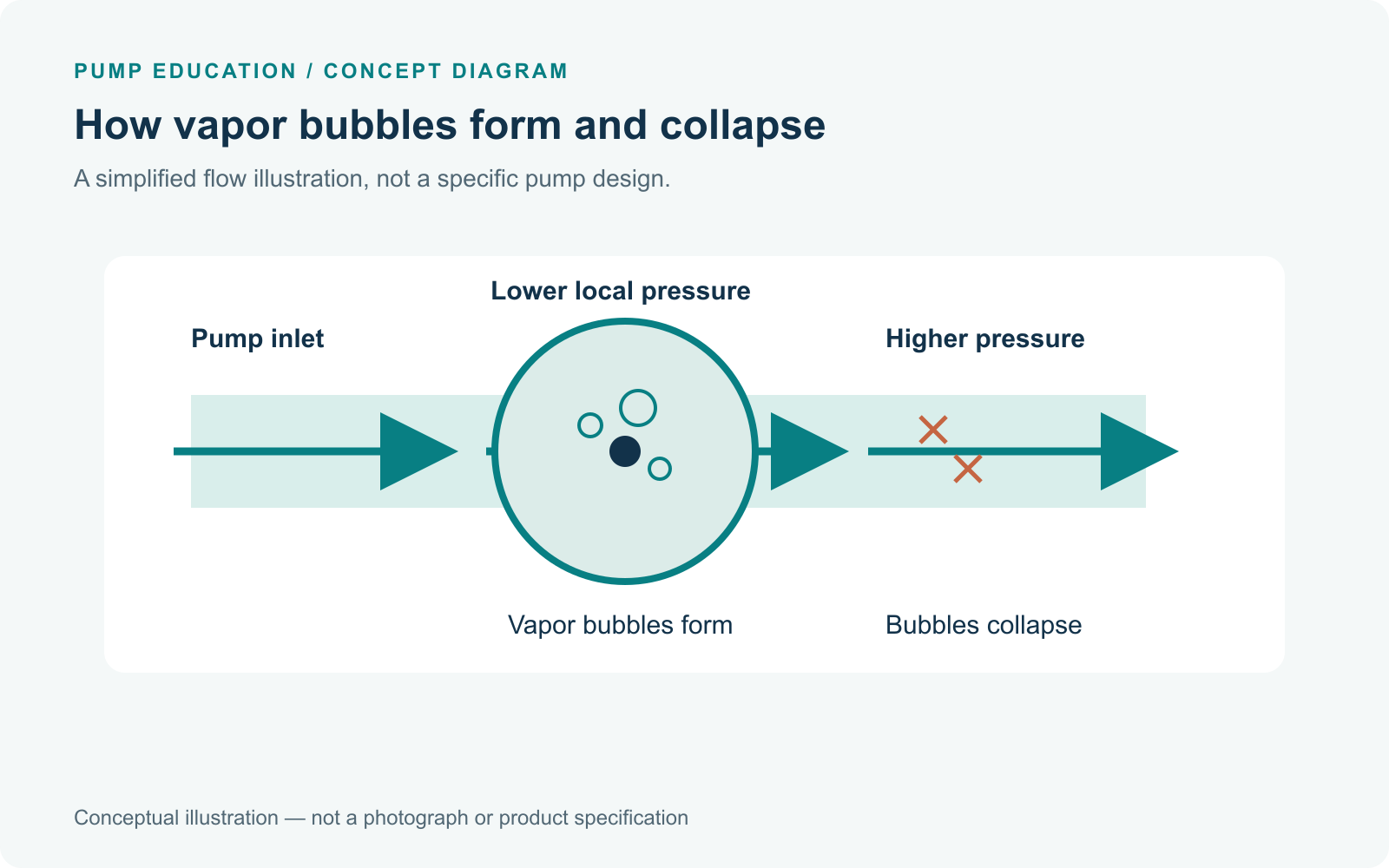
A conceptual flow illustration, not a specific pump design.
As liquid flows toward and through the impeller, its local pressure changes. If pressure in a region falls below the liquid's vapor pressure at its operating temperature, vapor cavities can form. When carried into a region of higher pressure, these cavities collapse. Repeated collapses close to a surface may cause pitting and erosion; unstable flow can also affect noise, vibration and performance.
Cavitation is different from air entering through a leaking joint. Both can interfere with operation and may sound similar, but the causes and corrective actions are not necessarily the same. The actual liquid and its temperature matter: the same installation can have different suction conditions when operating conditions change.
What causes pump cavitation?
Insufficient suction-side pressure
A low source level, substantial suction lift, a restricted strainer, a partly closed valve or excessive losses in the suction pipe can reduce pressure at the pump inlet. The system's configuration and liquid level should be evaluated at the intended flow—not inferred from the discharge gauge alone.
High liquid temperature
Vapor pressure generally increases as temperature increases. A suction system that provides adequate conditions with cooler liquid may need review at the maximum expected operating temperature. Record the fluid and actual temperature rather than assuming cold-water conditions.
Higher flow or a changed operating point
Suction-line friction and a pump's required NPSH can change with flow. Changes in system resistance, pump speed, parallel operation or equipment can move the operating point. Compare current readings with the manufacturer's curve for the actual pump, impeller and speed.
Suction piping or equipment restrictions
A long suction line, small internal diameter, bends, strainers and other fittings can contribute to pressure loss. Inspecting a suspected restriction is part of a site-specific assessment; components should not be altered or removed without evaluating the system and following the facility's procedures.
What are the signs of pump cavitation?
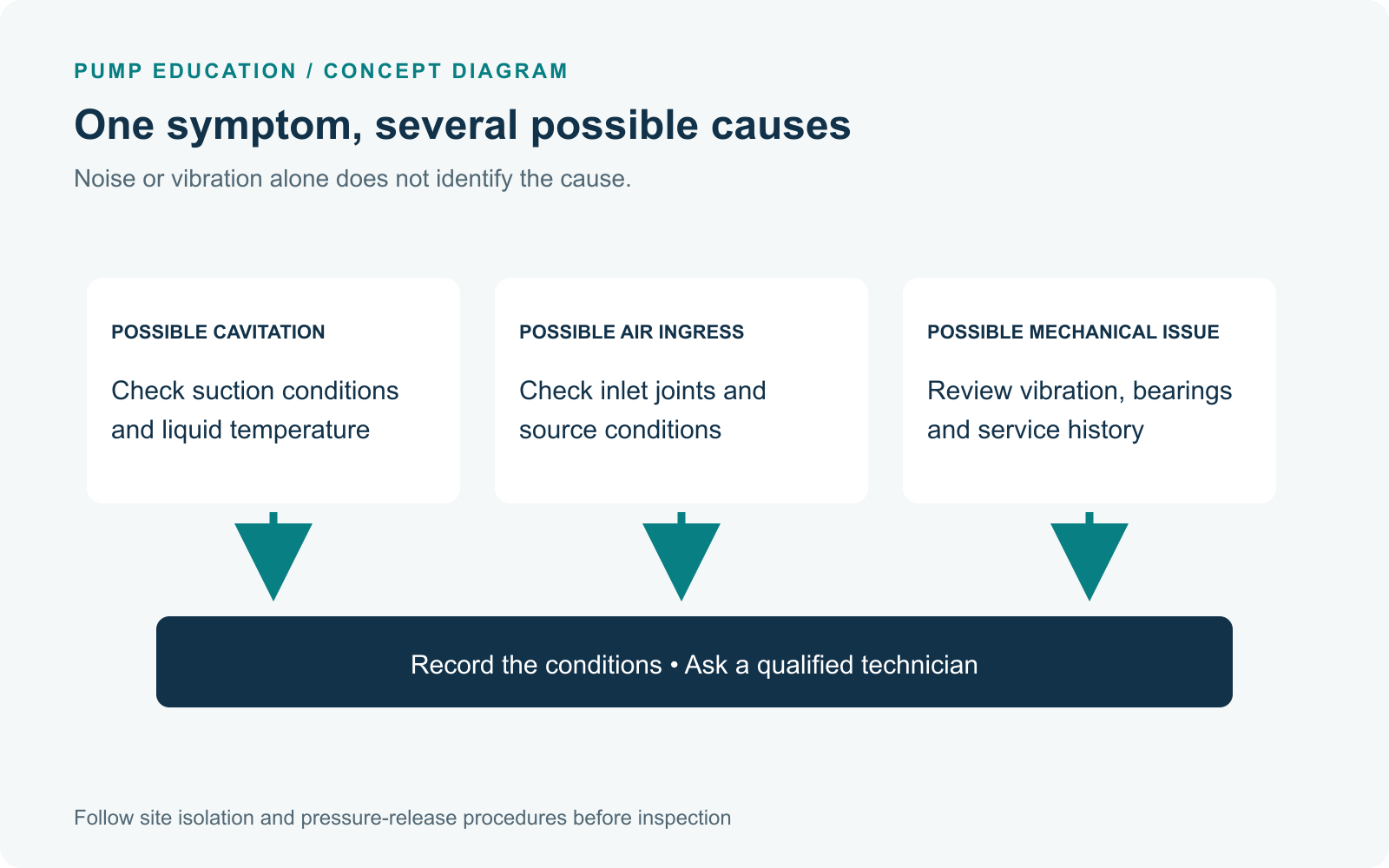
Symptoms can have several causes; use site safety procedures.
Possible signs include a crackling or gravel-like sound, increased vibration, fluctuating pressure, reduced flow or head, and pitting on impeller surfaces. Similar signs can arise from other causes, so look for a pattern and compare it with the conditions under which the equipment was operating.
| Observation | Possible explanations to investigate | Information to record |
|---|---|---|
| Noise or vibration rises as flow increases | Suction conditions, operating point, air ingress, mechanical or bearing issues | Flow, suction pressure, speed, temperature and when the noise occurs |
| Flow or discharge pressure is lower than expected | Restriction, air, worn parts, incorrect speed, changing system conditions | Suction and discharge readings, filter condition and recent changes |
| Pitting or erosion is visible | Cavitation is one possibility; material attack, solids and other mechanisms also require review | Location and photos of damage, fluid, operating history and affected components |
| Seal or bearing problems recur | Alignment, dry running, operating conditions, contamination and other causes | Service history, seal type, alignment and installation records |
A single symptom does not identify the root cause. Preserve readings and photographs so a qualified technician or pump supplier can compare them with the supplied equipment's documentation.
NPSHa vs NPSHr: what should you check?
NPSH stands for net positive suction head. In plain terms, it is a way to compare the liquid’s suction conditions with what the pump needs.
NPSHa is the net positive suction head available from the system at the pump inlet. It depends on source pressure, liquid vapor pressure, liquid level or suction lift and suction-side losses, among other conditions. The system designer calculates it for the relevant flow and temperature. If you also need the system duty, see the pump head calculation guide; total head and NPSH are separate checks.
NPSHr is the value required by the pump at a specified flow, speed, liquid and test criterion, as given by the manufacturer. It generally appears on or with the pump performance curve. It is not a fixed property of the entire installation.
Compare NPSHa with the manufacturer's NPSHr at the expected operating range using the applicable standard and supplier's recommended margin. NPSHr is linked to a specified test criterion; meeting it, or applying a generic margin without understanding the duty, does not guarantee the complete absence of cavitation. KSB's suction-characteristics explanation discusses NPSH and pump performance.
In our separate fictional curve example, NPSHr is shown as 8 ft at 100 US gpm. That number is not the site's NPSHa, an approved margin, or a PumpsHub product specification. The actual installation still requires its own calculation and review. Learn how to read a pump curve.
How to investigate and reduce cavitation risk
- Record the duty. Note liquid, temperature, flow, speed, suction and discharge pressures, source level, and whether the problem occurs at a particular operating point.
- Review the correct documentation. Confirm the actual pump model, impeller diameter and performance curve. Compare the observed duty with the manufacturer's operating range.
- Evaluate the suction system. Have the responsible technician examine source pressure or level, suction-side restrictions, pipe losses and air ingress. Calculate NPSHa for relevant operating conditions.
- Compare suction capability. Review NPSHa, NPSHr, test criterion and the margin appropriate to the application with the manufacturer or system designer.
- Review changes before modifying equipment. System layout, pipework, controls and operation all affect performance. Do not assume that changing a valve position, fitting or speed is safe or appropriate without an engineering assessment.
Follow the equipment manual and site isolation, electrical and pressure-release procedures before inspection. Hot, pressurized or hazardous liquids require the facility's specific precautions.
Example: what if the noise starts when the tank level falls?
Suppose a pump runs quietly with a full source tank, but becomes noisy when the level falls. A lower level may change the pressure available at the inlet. It is a useful clue, not a diagnosis: a restriction or an air leak could also be involved.
Record the tank level, flow and inlet pressure when the noise starts. Give those readings, the liquid temperature and the pump model to the responsible technician. They can check the suction system and compare the available suction conditions with the pump data. Do not assume a replacement impeller or seal will solve the problem.
Can cavitation damage a mechanical seal?
Unstable operation and vibration can contribute to equipment wear, but a failed seal does not prove cavitation. Dry running, misalignment, incompatible materials, contamination and installation issues are among other possible factors. Review the seal and pump together rather than ordering a replacement based only on the symptom. When considering a pump mechanical seal, check the dimensions, materials and compatibility for the exact pump.
Frequently asked questions
Does a noisy pump always mean cavitation?
No. Air ingress, bearing damage, loose components or another hydraulic or mechanical issue can also produce noise. Compare symptoms with the operating conditions and inspect according to the manufacturer's instructions.
Is cavitation always caused by a low tank level?
No. Low source level is one possible contributor; temperature, suction losses, liquid properties and operating flow also affect the suction conditions.
Does NPSHa above NPSHr guarantee no cavitation?
No. NPSHr is stated using a particular test criterion. The necessary margin depends on the equipment and application, and meeting the reported value does not prove that cavitation is absent.
PUMPSHUB · PROJECT INQUIRY
Need to discuss your pump operating conditions?
Share the liquid, temperature, flow, source conditions and available pump data. We can review the information needed for your inquiry.