
A pump curve is a chart that shows how a pump performs at different flow rates. To use it, first find how much liquid you need to move. Then check whether the pump can provide that flow against the head your system requires. Head is a way to describe the energy the pump adds to the liquid; it is shown in feet or meters.
In this guide, you will learn how to read the chart, spot a possible mismatch and tell a supplier what to check. A pump curve applies to a particular model, speed and impeller size. The impeller is the rotating part inside the pump that moves the liquid.
That is the starting point—not the entire selection. A pump that appears to reach a desired point on one line still needs to match the system curve, the fluid, the motor supply and the manufacturer's operating limits. The Hydraulic Institute's pump-curve overview explains the relationship between flow, head, efficiency, power and NPSH required.
The short answer: three checks before you buy
- Find your target: How much flow do you need, and what total head must the pump provide at that flow?
- Read the right line: At that flow, check the head for the offered model, speed and impeller size.
- Check the rest: Ask for the pump’s operating range, efficiency, power and suction requirements. A match on the head line alone is not a complete selection.
Do not know your head yet? Start with the head calculation guide, or send the supplier your pipe and tank details.
What information does a pump performance curve show?
A centrifugal pump performance curve is normally supplied for a specific pump model and speed. Some sheets show several curves for different impeller diameters. Other information may appear on the same chart or in separate graphs.
| Curve or label | What it tells you | Why a buyer should check it |
|---|---|---|
| Flow and total head | Head the pump develops at a given flow for the stated configuration | Whether the pump can meet the system's required duty |
| Impeller diameter | Which impeller size the head-flow line represents | The offered diameter must match the curve being reviewed |
| Efficiency | Pump efficiency at different flows | Operating far from the best efficiency point can affect energy and reliability |
| Input power | Power absorbed by the pump at different flows | The motor must be suitable for the expected operating range |
| NPSHr | The suction head the pump requires at a stated flow and test condition | Compare it with what the system can provide, using the applicable margin |
Make sure you are reading a centrifugal pump curve. Other pump types may use different axes and operating assumptions. Check whether efficiency is for the pump alone or the complete motor-pump unit.
Before reading: define the duty point
Your design duty is a required flow and the corresponding total head imposed by the system. For example, “100 US gallons per minute at 65 feet of head” is a more useful starting point than “a 5 hp pump.” The flow rate should come from the application; the head should be determined from the actual system and conditions.
The design point is a target. In operation, the pump's actual point is determined by the intersection of the pump curve and the system curve. If the system changes—for example, if filters become loaded or a tank level changes—the operating point can move. Review the expected operating range rather than just one nominal point.
If you need to estimate the system requirement first, see Pump Head Calculation: How to Estimate Total Dynamic Head.
How to read a centrifugal pump curve step by step
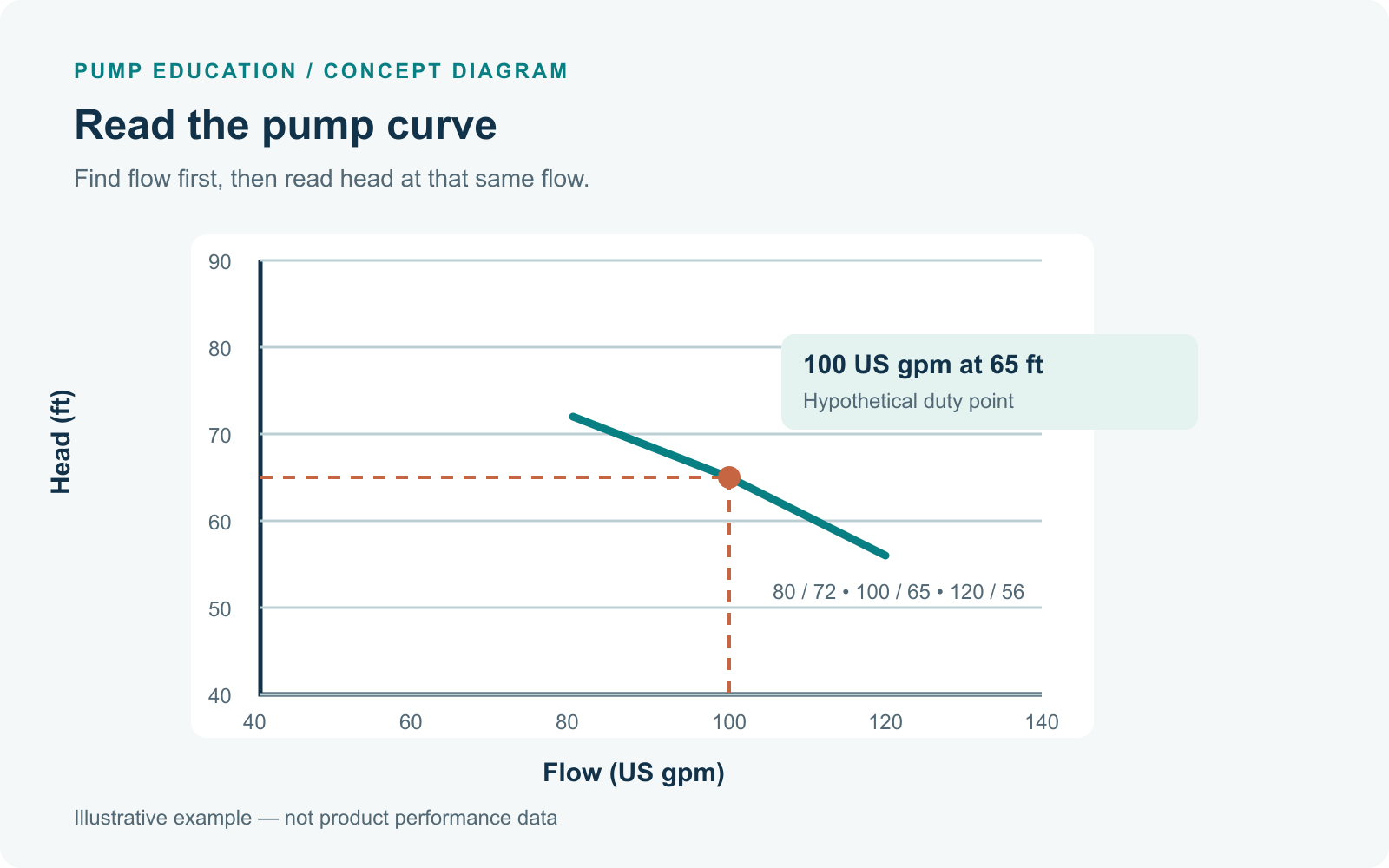
An illustrative curve, not a product performance chart.
1. Identify the model and test conditions
Find the pump model, impeller diameter, speed, frequency and liquid or test conditions. Confirm that the curve corresponds to the configuration in the quotation. For a stainless steel centrifugal pump, request the curve for the exact offered configuration. A curve for another impeller or a different electrical frequency is not automatically valid for the offered pump.
2. Find the required flow
Locate flow on the horizontal axis. Common units include US gpm and m³/h. At 100 US gpm, the equivalent flow is approximately 22.7 m³/h. Ensure that you are using US gallons if the chart says US gpm.
3. Read head on the correct impeller line
Move up from the flow value until you reach the line for the proposed impeller diameter. Then move across to the head axis. Head is commonly shown in feet or metres of liquid; 65 ft is approximately 19.8 m.
Compare this value with the system head at the same flow. A high shutoff head or maximum catalogue flow alone does not demonstrate that the pump meets the duty.
4. Check efficiency and the operating range
At the same flow, read the efficiency line or contour. The best efficiency point (BEP) is the flow at which pump efficiency is highest for the specified speed and impeller. A suitable selection also considers the manufacturer's preferred and allowable operating ranges, expected variability and service conditions. “Closest to BEP” is useful guidance, not a substitute for model-specific limits.
5. Read the input-power curve
Check pump input power at the duty point and across the expected operating range. This is not always the same as motor nameplate power or electrical input power. Motor selection also depends on the liquid, operating conditions, available electrical supply and applicable service requirements.
6. Compare NPSHr with system NPSHa
NPSH means net positive suction head: a measure used to check conditions at the pump inlet. NPSHr is the value the pump requires; NPSHa is what the system can provide. Read the manufacturer's NPSHr at the same flow and stated conditions. The system designer evaluates NPSH available, or NPSHa, using the liquid, temperature, source pressure and suction-side conditions. Check the applicable margin and operating range with the pump supplier. NPSHr is defined against a test criterion; exceeding that value alone is not proof that no cavitation can occur.
For the operating problem behind this check, see What Is Pump Cavitation?.
Worked example: read one operating point
The table below is a fictional teaching example, not a manufacturer test, selection chart or product specification. Assume a single impeller and constant speed. The system designer has estimated that water service requires 100 US gpm at 65 ft. Also assume the system and this illustrative pump curve intersect at that point.
| Illustrative flow, US gpm | Illustrative pump head, ft | Pump efficiency | Pump input power, hp | NPSHr, ft |
|---|---|---|---|---|
| 80 | 72 | Not specified | Not specified | Not specified |
| 100 | 65 | 60% | 2.74 | 8 |
| 120 | 56 | Not specified | Not specified | Not specified |
At 100 gpm, the illustrative head is 65 ft; that matches the assumed system requirement. The hypothetical efficiency and input power are values for that point, not independent guarantees. For a rough consistency check, water hydraulic power is 100 × 65 / 3960 ≈ 1.64 hp; dividing by an assumed 0.60 pump efficiency gives approximately 2.74 hp pump input. Actual motor selection requires the manufacturer's power curve across the operating range and electrical considerations.
The hypothetical NPSHr of 8 ft must be checked against the system's calculated NPSHa and the applicable margin. It does not tell us what NPSHa the installation provides. The fictional table also does not show a complete curve, so it cannot establish the BEP or operating limits.
What would make this example a no-go?
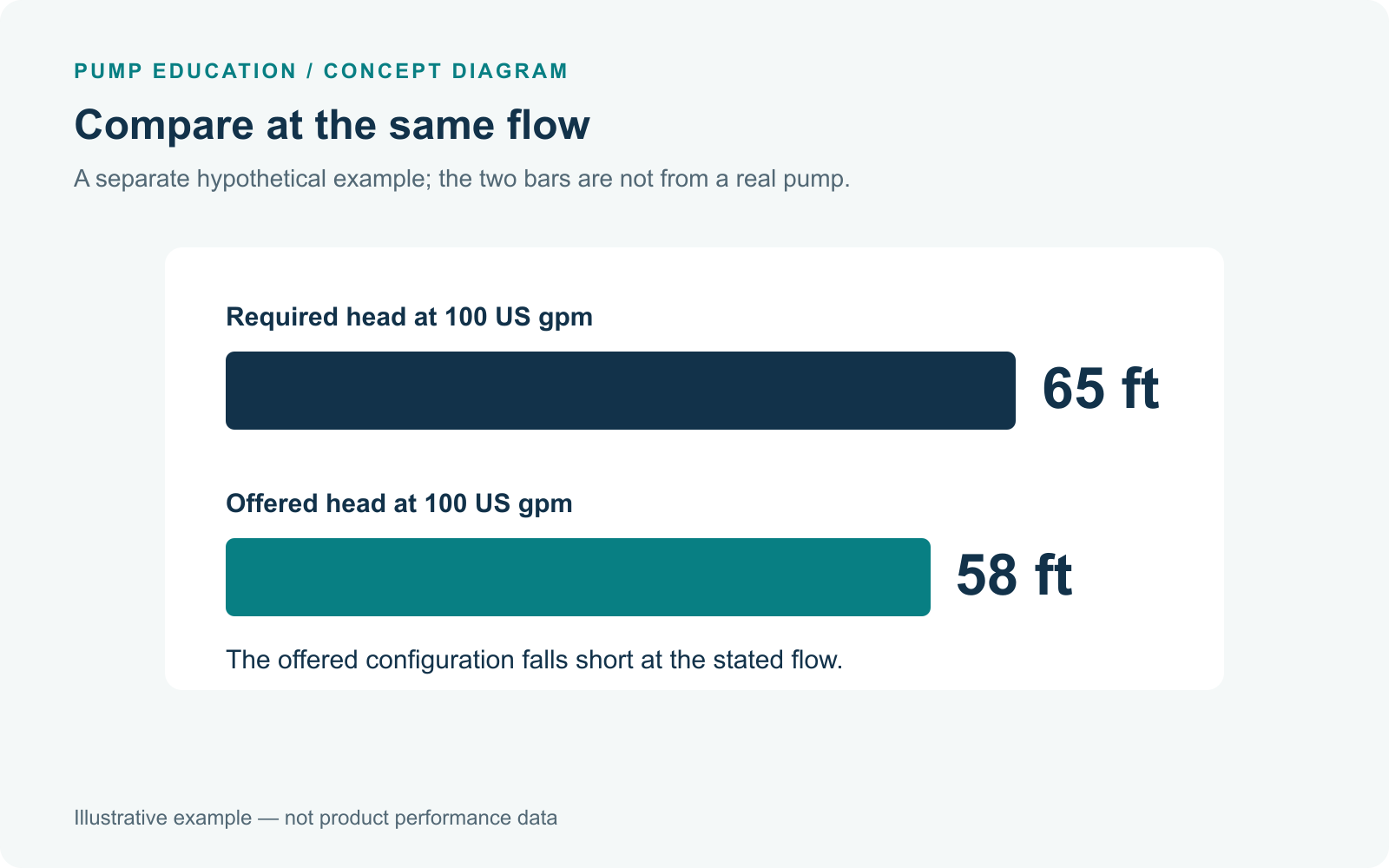
A separate hypothetical example, not a real pump.
Suppose the supplier’s offered curve gives only 58 ft of head at 100 gpm, but your system needs 65 ft at that same flow. That configuration does not meet the stated target at 100 gpm. Ask the supplier to review the system and another suitable configuration. A larger maximum head somewhere else on the chart does not change this comparison.
This is a second teaching example, not a test of an actual pump. The actual operating point depends on the whole pump and system curves.
Common mistakes when comparing pump curves
- Comparing maximum flow on one pump with maximum head on another, even though they occur at different points.
- Reading a curve for the wrong impeller, speed or frequency.
- Treating the design point as the actual operating point without checking the system curve.
- Ignoring the temperature, density or viscosity of the actual liquid and any required corrections.
- Choosing a motor from one point without checking the expected operating range.
- Assuming NPSHr is the available NPSH or that a nominal margin guarantees cavitation-free operation.
What should you request before ordering?
Ask for the curve and technical sheet for the exact offered model, impeller and motor. Share your normal and expected operating range, fluid properties, suction conditions, supply voltage and frequency, connection standard, required materials, quantity and destination. Ask which test reports or certificates are available for that configuration.
The U.S. Department of Energy's pumping systems sourcebook provides additional guidance on system curves and pump selection.
Frequently asked questions
Is the duty point the same as the best efficiency point?
No. The duty point is the flow and head required by the system, while BEP is the flow at which the pump reaches its highest efficiency for the stated configuration. Selection should consider both and the manufacturer's operating limits.
Can I use a 50 Hz curve for a 60 Hz pump?
Do not treat it as confirmed performance. Request the correct curve for the actual speed, frequency and impeller. Any conversion or correction should be checked by the supplier for that pump.
Is the highest-efficiency pump always the right choice?
Not by itself. The pump must also meet the operating range, suction conditions, fluid compatibility, power and maintenance requirements.
PUMPSHUB · PROJECT INQUIRY
Need to compare a pump curve with your duty?
Share your required flow and head, fluid, suction conditions and power supply. We can discuss the configuration and relevant documentation.